Two Faced: AXI breathes new life into 3 Hardman Street
This article first appeared as part of Mix Interiors issue #241
Photography: Josh Kemp Smith
Thanks to AXI’s design intervention, 3 Hardman Street’s new entrance experience doesn’t have a bad side.
From suits gesticulating into iPhones to the clack of stiletto-heeled gaits, anyone that finds themselves in Spinningfields at 8:00am on a weekday will understand that they’ve stumbled upon Manchester’s professional services district, dubbed by many as ‘the Canary Wharf of the North.’ Stroll a little further and one arrives at the choppiest intersection of Hardman Square – a crossroad where The Ivy’s leafy pavilion abuts the chrome of the city’s most sought-after workplace rentals.
Amongst them, 3 Hardman Street stands 16-storeys from the pavement, once prized for being the largest speculative office development outside of London. The building, designed by Sheppard Robson in 2009, was ostensibly greenlit with zero tenants in mind, however – on account of its spacious floorplates and ample natural light – was 80% let before the last tool was downed.
Sixteen years later, and at 395,000 sq ft, 3 Hardman Street still operates as a destination workplace as much today as it did at its inception, with the likes of international lawyers, asset financiers and investment bankers passing through its doors every day.
Naturally, with many occupants comes many entrances, and the reception areas to the east and west were crying out for an uplift. To bring the arrival sequence out of the noughties, global property management company Mapletree enlisted AXI to provide employees (approaching from both sides of the street) with a warmer welcome as well as an array of elevated, hospitality-inspired amenities.
AXI’s ethos is manifest in interiors that flow with an existing architectural framework, drawing influence from what already ‘is’ to bring forth something both considered and new. All lightwells and bright white walls, AXI worked with the westside’s vertical volume as a starting point, transforming the clean-cut threshold into an inviting, contemporary hub for staff to wait, meet or collaborate. At its core, a whirling sculptural form, smudged in hand-trowelled plaster, conceals the staircase to the mezzanine level; the same contours are mirrored in the new front desk across the way, which channels employees to the lift foyer beyond.
The decision to keep the space between the interacting masses open was intentional, stemming from the types of activities observed in an early site visit. Co-Founder of AXI Sarah de Freitas explains, “When we first visited, there was a community event [happening] with stands lining the reception walls. This became one of the key drivers, as the client wanted a place where they could hold events easily and where participants could set up real stalls rather than just flip-flop tables.” As indoor markets and charity fundraisers had previously brought brokers from behind their desks, an unobstructed throughway meant that building management could continue to appropriate the space as before, encouraging dwell time and B2B interactions.
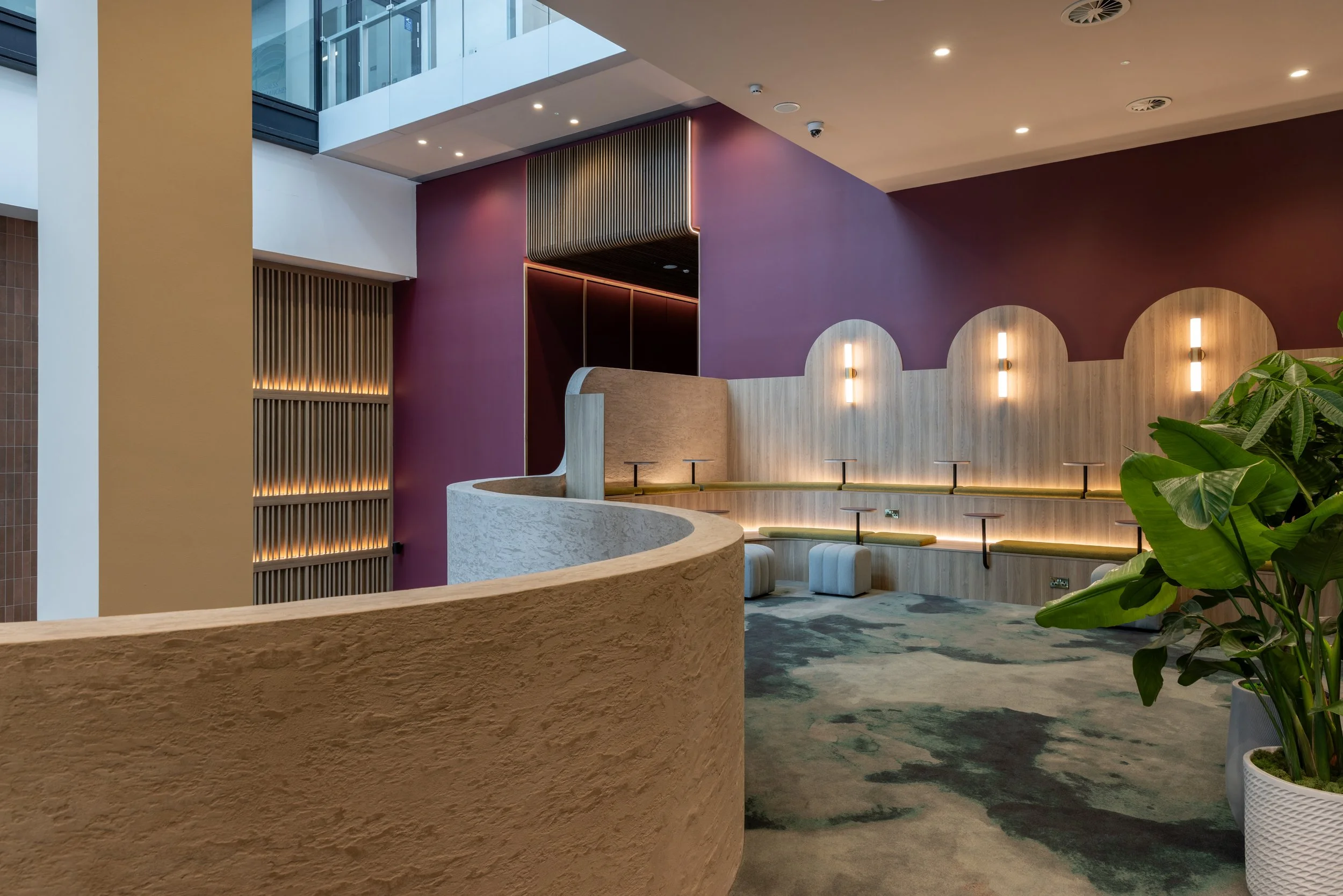
With harlequin-like fabrics, punchy jewel tones and velvet drapery – off centre, a network of seating enclaves wrap the staircase, providing private and more exposed nooks for solo tasks, relaxation or small group work. The den-like quality of this area contrasts the canopy above. A resident medical examination board swayed AXI’s approach for the upper level, with lecture hall-style seating and sufficient space for standing (on a mesmerising surface pattern by Ege carpets, no less) being baked into the design. Up to 30 students at a time are expected to congregate here, de Freitas shares, so a designated area for last minute cramming sessions was crucial.
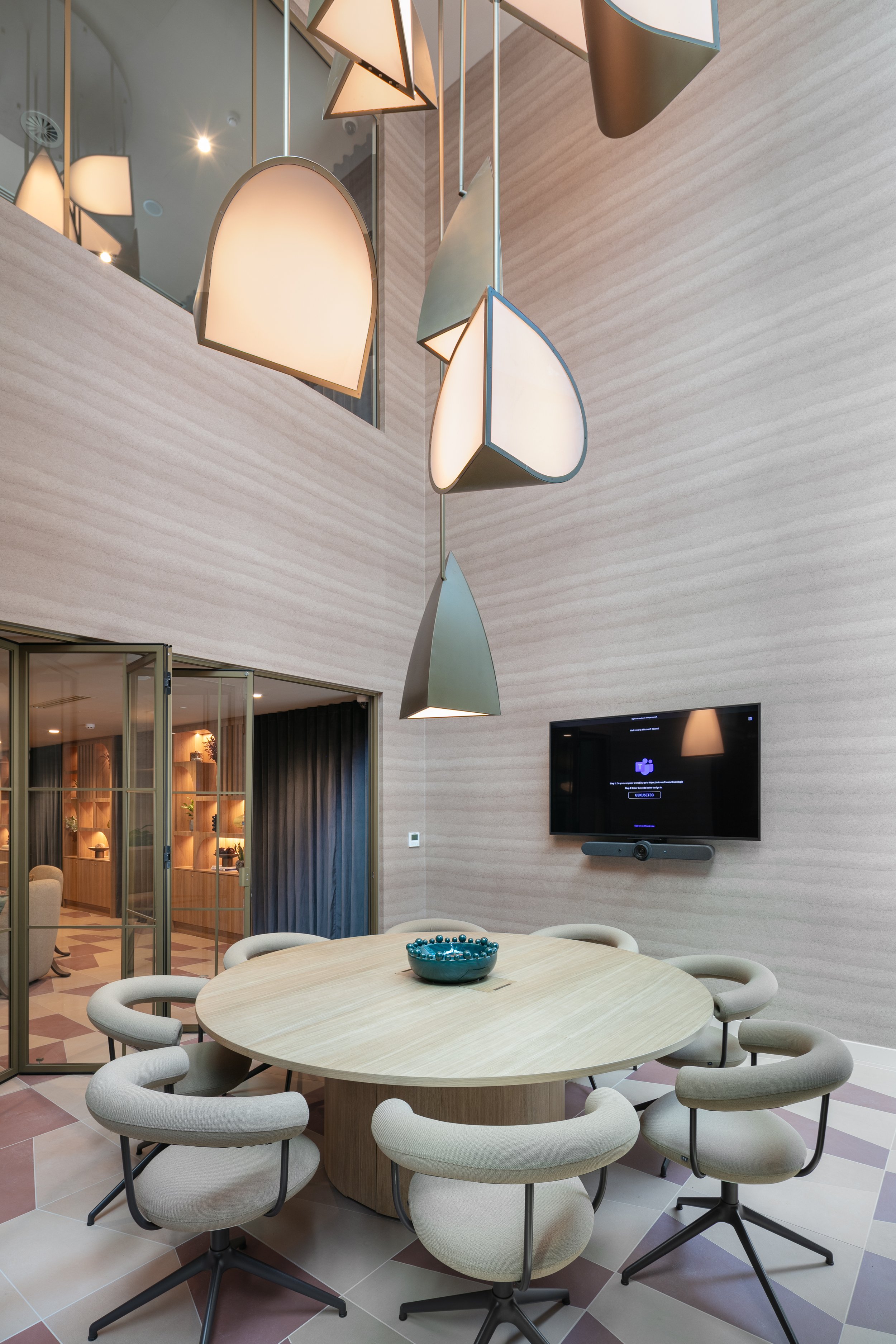
Building occupants can also make use of the west’s meeting room – an area primed for formal discussions and presentations. With views across Hardman Square, AXI stopped the mezzanine short of the glazed façade, creating a double height space within what is actually compact square footage. Rammed earth-effect wallpaper and a custom chandelier by Tyson Lighting, the space acts almost as a retailer’s window display, advertising an opulent new era for the 3 Hardman Street brand.
Panning easterly, the second entrance offers an entirely different mood, but maintains AXI’s community-focused intent. When asked about how the design compared to the project’s westside story, de Freitas offers, “Over in the east – given its lower ceiling heights but more expansive footprint – the general feel for this space was a lot more open and airier to accommodate larger social events.”
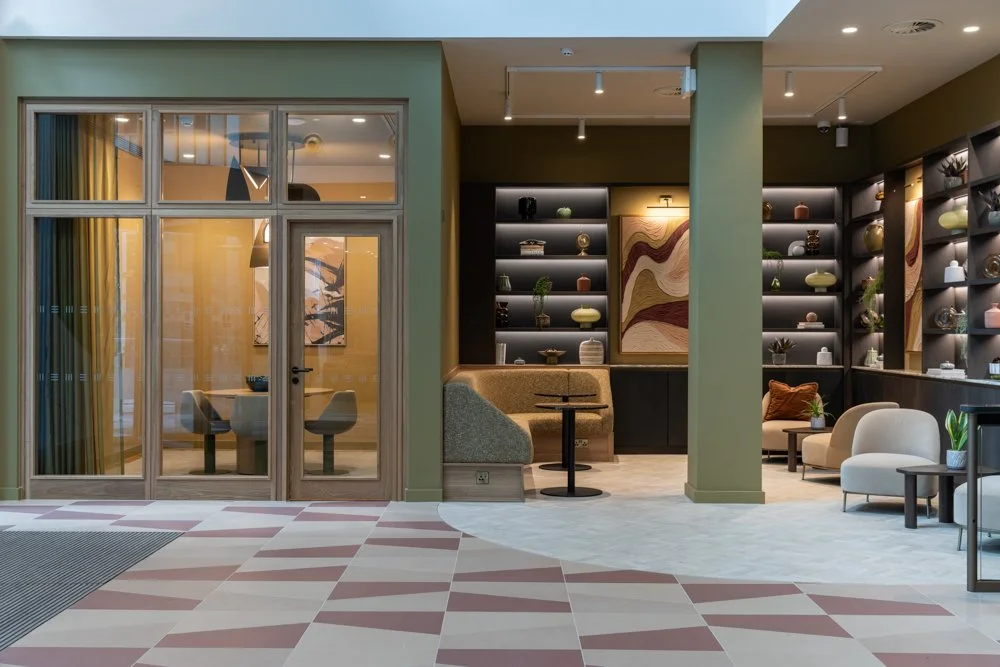
A library corner was an integral part of the brief, with the east being identified not only by its reception utility but also by wholesome book swapping rituals between tenants. “In the east, a free-standing [book shelving] unit was isolated within the space with no consideration of user interaction or a place to enjoy the books,” de Frietas comments, “We ensured an intentional space was recognised, creating a place where people were able to read while allowing for easy communication and connections between tenants.” Now, bespoke millwork, boucle upholstered chairs and swirling impasto works by artist Millie Buckland set the scene.
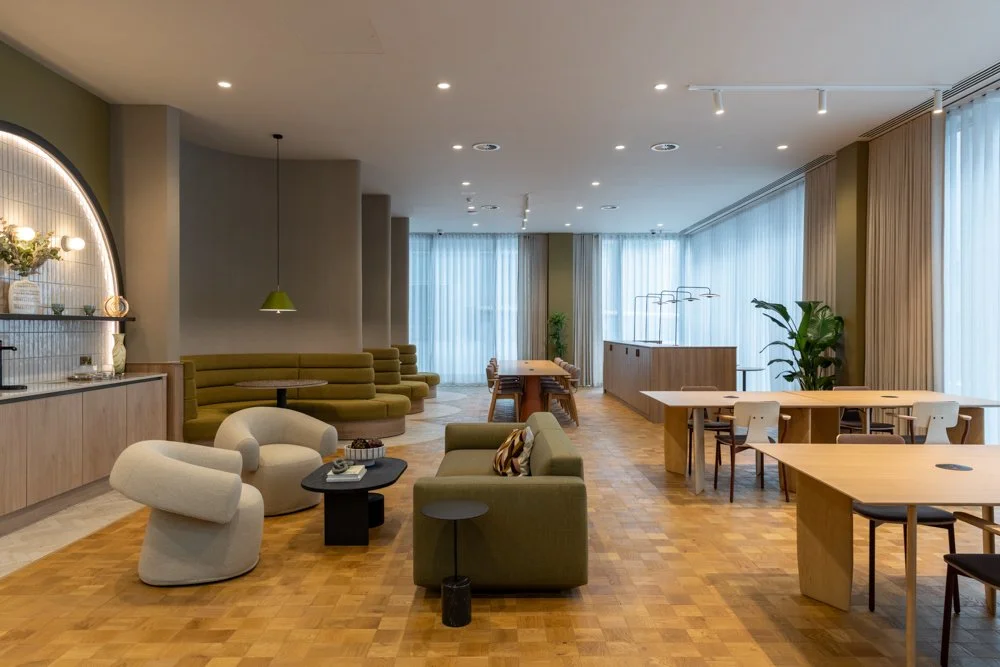
Divided by the path to wider circulation, the east’s coworking and events space is laterally designed and flexible, with custom-built elements fixed around the perimeter and a moveable mix of FF&E at the centre. Underfoot, Tedd Todd reclaimed timbers transition to jauntily arranged pink tiles, creating passive zoning in a floorplan designed for adaptability.
Formerly characterised by its corporate gleam, AXI have crafted two grounded frontages that are imbued with the warmth and comfort of a boutique hotel, catering to professionals’ shifting appetite for plush upholstery and mobile workflows more than, say, swivel chairs and rigid monitors. With 3 Hardman Street, the team have demonstrated a deep understanding of the wonts of a post-pandemic workforce, delivering a project that truly represents ‘the new face of working.’